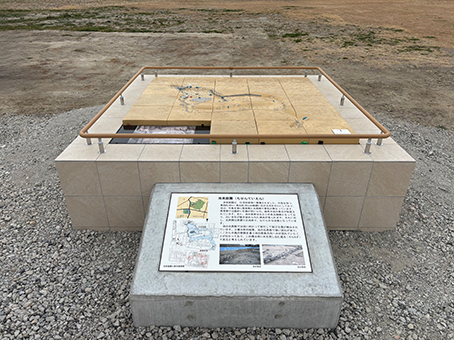
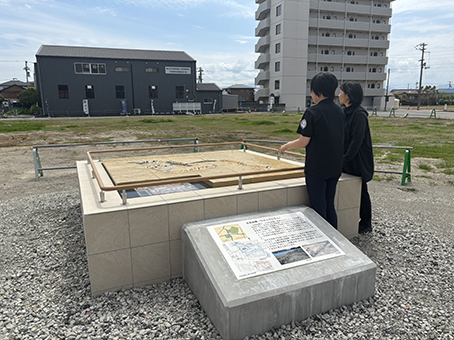
Otsuka Omi Ceramics has created a ceramic board model of the pond-and-garden* discovered during excavation surveys as part of the “Shōzui Castle Ruin Preservation and Development Project” being carried out by Aizumi Town, Tokushima Prefecture. The model was completed in March 2026 and is currently open to the public.
*A garden featuring a pond or similar water feature
The Nationally Designated Historic Site “Shōzui Castle Ruin,” which conveys the history of Awa
The Nationally Designated Historic Site “Shōzui Castle Ruin,” located in Aizumi Town, Tokushima Prefecture, is an important historic site believed to be the residence of the Hosokawa clan, the shugo (provincial governors) of Awa, and the former site of the castle of the Miyoshi clan, who ruled Awa Province during the Warring States period. With the aim of preserving and utilizing this historic site, the town began excavation surveys in fiscal year 1994 (Heisei 6) with funding from the Ministry of Education, Culture, Sports, Science and Technology.
Excavation of One of Japan’s Largest “Pond-and- Garden”
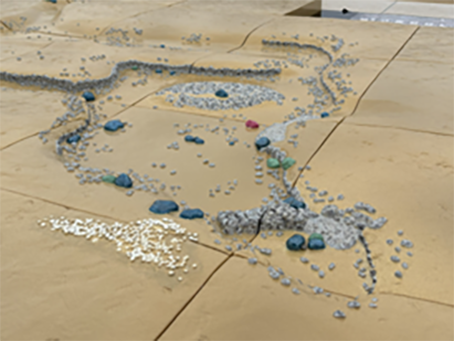
As part of efforts to preserve this historic site, surveys were conducted while working to acquire the former factory site for public ownership. During these excavations in fiscal years 2004 and 2005, the remains of a pond-and-garden complex were discovered. The pond-and-garden confirmed by the excavation is considered one of the largest in the country, with a pond measuring approximately 40 meters east-west and 30 meters north-south, featuring a central island.
Reference: Nationally Designated Historic Site “Shōzui Castle Ruin(Shōzui-jokan-ato)”
Preserving the “Visible Form” — A Reconstruction Using Ceramic Boards
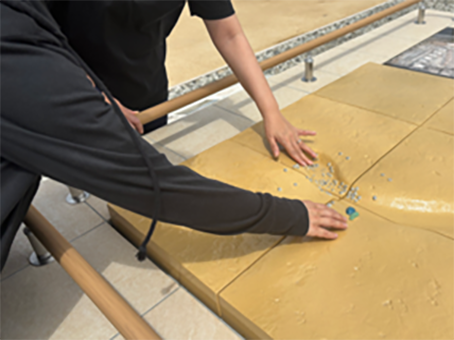
The excavated pond-and-stream garden site had to be backfilled for preservation purposes and could not be displayed in its original state. Therefore, Aizumi Town decided to create and display a model as a way to pass on the excavated state of the garden to future generations and allow visitors to experience it firsthand. The method chosen for this reconstruction was our company’s ceramic board technology, which offers excellent weather resistance and durability while enabling a wide range of expressive possibilities. Ceramic boards were selected for the production because they are suitable for outdoor display and can retain their color and texture over the long term.
During the production process, we conducted extensive discussions with officials and stakeholders from Aizumi Town. Based on the findings of the excavation survey, we meticulously recreated the garden’s layout, the shape of the pond, and the arrangement of scenic stones.
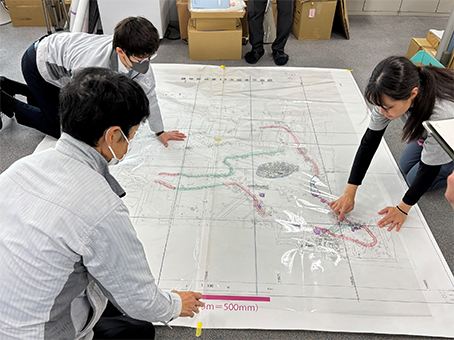
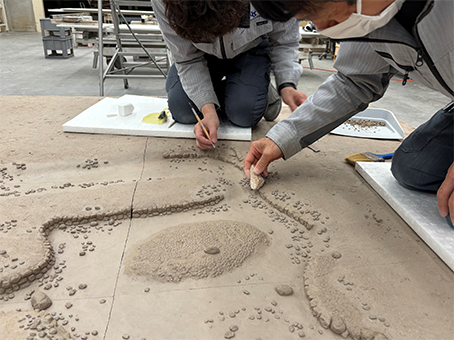
Our ceramic boards are used to preserve cultural properties and promote local history, and this model of the pond-and-garden landscape is part of our ongoing effort to pass on the region’s valuable historical assets to future generations in a tangible form.
Please feel free to stop by if you are in the area.