On July 5, 2025, at the Japan Society for the Science of Cultural Properties held in Fukuoka, we presented two case studies under the theme “The Potential of Ceramic Boards in the Preservation and Utilization of Cultural Properties” during a corporate presentation.
Additionally, at our corporate exhibition booth, we displayed and introduced the “Takamatsuzuka Tomb Wall Painting: West Wall, Group of Women” and the “Kunohe Castle Ruins: Earthen Rampart Cross-Section,” allowing many visitors to experience an exhibition where they could see and touch the exhibits.
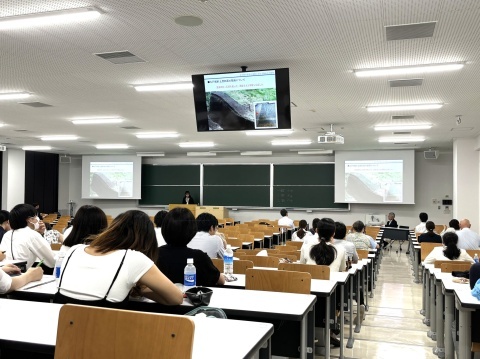 Corporate Presentation
 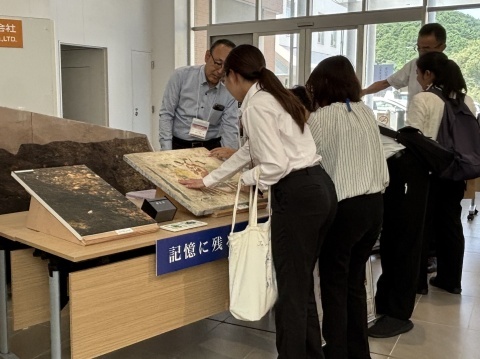 Corporate Exhibition Booth
 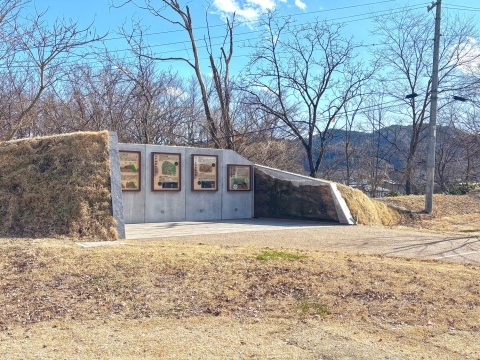 Kunohe Castle Earthenware Cross-Section Display Facility (Ceramic board on the inner wall to the right in the photo)
 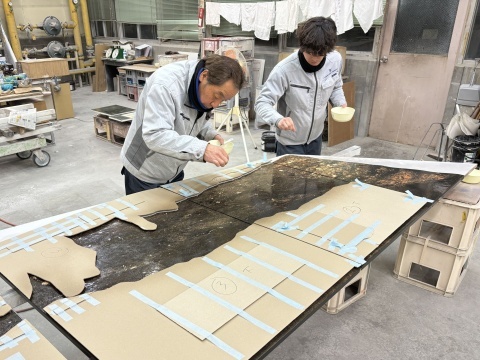 Production Process: Texture Expression (Application of Materials with Different Grain Sizes)
◆Corporate Presentation
① “Utilizing Ceramic Boards at the National Historic Site Kunohe Castle Ruins and Earthen Rampart Cross-Section Display Facility” (Iwate Prefecture)
The earthen ramparts surrounding Kunohe Castle feature distinctive structures with rammed earth-like deposits.
The Cultural Properties Division of Ninohe City sought a novel presentation approach, aiming to “foster a deeper understanding of rammed earth through sensory engagement.” After extensive deliberation, inspired by other case studies presented at last year's academic conference, ceramic boards were selected for their durability, reproducibility, and tactile appeal. Through repeated adjustments to color and texture, the exhibition was completed, enabling visitors to “view, touch, and feel the history” of the earthen rampart cross-section.
According to city officials, the display is now recognized as a highlight of the historic site.
※Earthen rampart: A defensive wall built by piling earth like a levee to prevent enemy invasion.
※Rammed earth construction: A construction method where wooden boards are erected, and tools like “octopus” (tako) or “ramming rods” are used to compact layers of different types of soil and gravel one by one.
② “Utilizing Ceramic Boards for Shell Layer Cross-Section Display at National Historic Site Kaigara-yama Shell Mound” (Aichi Prefecture)
This area is believed to have had a coastline extending close by during the Yayoi period, where fishing flourished over time, gradually forming the shell mound.
Ceramic boards were chosen for their durability, resistance to deterioration, and ability to clearly display the low-information shell layer cross-section. For this project, the challenge was to make the shells easily visible outdoors in natural light while applying image processing appropriate for the shell layer. Through careful retouching, a detailed shell layer cross-section was successfully completed.
The project manager commented, “It has broadened the scope of what people can learn and see.”
Through these examples, we conveyed the strengths of ceramic plate displays at outdoor archaeological sites and ruins: ① No fading ② Resistant to friction and wear = can be touched ③ Excellent weather resistance ④ Conveys the immediacy of discovery ⑤ Can meet custom-made expectations.
We believe that creating replicas as “real objects” that can be touched directly contributes to the preservation and utilization of cultural properties by creating new opportunities for appreciation. We will continue to expand the possibilities of ceramics and pass on culture through ceramics.